Cuban cigars have been an integral part of the island’s culture for centuries. Their origins can be traced back to 1492 when Christopher Columbus and his sailors first encountered indigenous people smoking tobacco leaves. By the 16th century, Cuba had established itself as the premier producer of tobacco, with the first Cuban cigar factory set up in 1542.During the 19th and early 20th centuries, Cuban cigars became the preferred choice for royalty, celebrities, and world leaders. Even after the Cuban Revolution and the subsequent U.S. embargo in 1962, which prohibited the sale and purchase of Cuban cigars in the United States, their reputation only grew. The inability to legally acquire them in the U.S. contributed to their allure, making them a symbol of luxury and forbidden indulgence.
The Unique Terroir: Why Cuban Tobacco Stands Out.
One of the most defining characteristics of Cuban cigars is their terroir—a term borrowed from the wine industry that refers to the natural environment in which the tobacco is grown.Cuba’s westernmost region, Vuelta Abajo in Pinar del Río, is renowned for producing some of the finest tobacco in the world. The soil in this region is rich in essential nutrients such as magnesium, calcium, and iron, all of which contribute to the unique flavor profile of Cuban tobacco.
Magnesium: Balances acidity and enhances smoothness.
Calcium: Adds sweetness and improves combustion.
Iron: Contributes to the aroma and depth of flavor.
The climate, with its ideal balance of sun, rain, and humidity, further enhances the tobacco’s quality.
No other country in the world has been able to replicate the growing conditions of Cuba perfectly, which is why Cuban cigars continue to maintain their prestigious reputation. Cuba perfectly, which is why Cuban cigars continue to maintain their prestigious reputation.
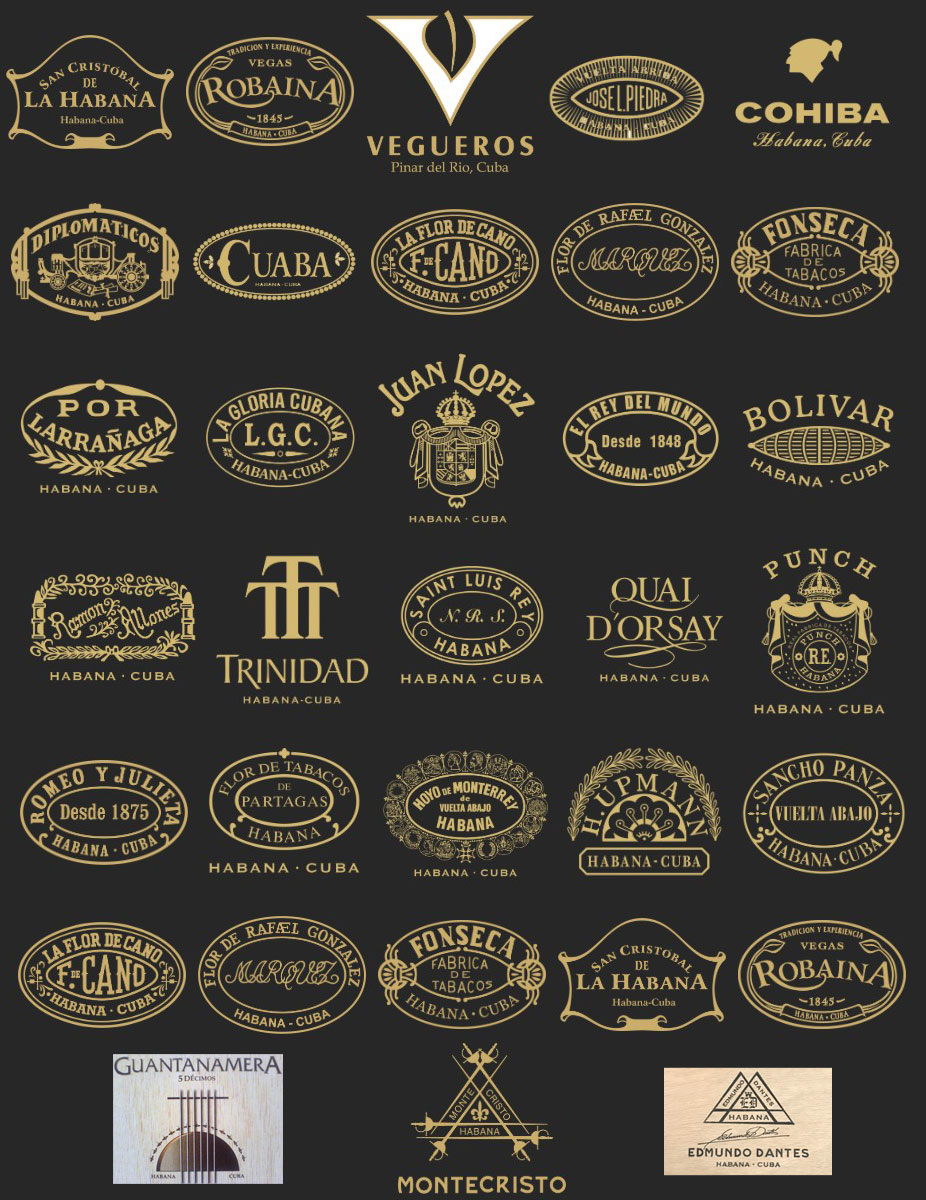
Robaina
Vegueros
Flor De Cano
Jose L. Piedra
Cohiba
Juan Lopez
Rafael Gonzalez
Fonseca
Por Larranaga
La Gloria Cubana
Punch
Bolivar
Ramon Allones
Trinidad
Saint Luis Rey
Qual Dorsay
Romeo y Julieta
San Cristobal
Rafael Gonzalez
Cuaba
Partagas
Hoyo De Monterrey
H. Upmann
Sancho Panza
Flo Cano
Diplamaticos
El Rey Del Mundo
Guantana
Montecristo
Edmundo Dantes
San Cristobal
Robaina
My Opinion:
I kind of break down my admiration of and for Cuban cigars in a few different ways. Before flavor, texture, and construction finally hit me over the head, I couldn't tell one cigar from the other and I saw and tasted them pretty much all the same with the exception of a few real cheap machine rolled sticks that who knows what they were made of. It took me somewhere around 2 years and a at the minimum of 50 different brands and series of cigars before something clicked in the buds of taste that literally shocked me to the point I was even scared. I could actually taste the different notes of flavor everyone was talking about that I thought was just a myth. To me it was an experience that shock me because all of a sudden, everything up to that point tasted, smelled and looked the same with looks having the only variation. It was one of those moments you can't forget like losing one's virginity. If you forget that, you're not of the human species. In any event, I wasn't smoking just to blow smoke rings but found smoking relaxing and I did enjoy the generic flavor I was getting until I wrapped a lip around an Arturo Fuente Hemingway. During the process of lighting the cigar I noticed something right off something was different. right away I could distinguish a very distinctive flavor and aroma of coffee and cream with a slight hint of cocoa. This remained until about halfway down the body of the cigar until a mild bite of black pepper combined with the coffee and cocoa that to me, completely changed the flavor to a semi-bitter chocolate with an espresso hint. This flavor remained to the finish. So what happened? This is the part that was kind of scary, how could I all of a sudden start tasting things that weren't there before? Skipping all the experimental takes and wild ass guesses, it turns out that when I lit-up that Hemingway, I was tired, relaxed and pretty much empty of any serious thought and just wanted to sit back with a cigar and maybe watch some T.V. Absent any life anxieties I was able to focus on the cigar alone. I remember that Hemingway was my first AF cigar and I wanted to see if my generic taste buds could find any difference. They did. Now with that, I can't credit the fine flavors of that Hemingway alone for the magical moment, rather the psychological effect gets the prize. I no longer question the effects one's mind can play into almost any situation. You may notice this effect yourself, for me it is profound. I no longer just grab a cigar a smoke it, I select a cigar and savour it. You will never see me working outside in the garden or doing anything that takes the bulk of my thoughts off the cigar. Imagine cleaning out your garage working up a healthy sweat then, in the heat of thirst, you chug down a fine white wine. To me that's in the same ridicules neighborhood of smoking a cigar not having any thought towards what you are smoking.
So, after many many years of fine tuning my taste buds for premium cigars, I think I have come to a place where I can accurately describe what I am smoking, and at least to how flavours meet my particular and subjective pallette. I fully understand that these flavours can meet the pallet of others differently. This difference can also be found in they way we each interpret the flavours of food, drinks and the aromas of nature itself. So now, I offer my opinion on Cuban cigars.
I think like all of us, I was very interested in what all the fuss was about Cuban cigars. Social media cigar groups were and still remain full of Cuban cigar experts. This experts are highly qualified individuals that have experience far above the standard aficionado. Their credentials include but may not be limited to: Many trips to Havana where they have toured all the factories, intimately know management personnel, are friends with founding family members of top Cuban brands, have visited tobacco farms throughout Cuba, toured aging and fermenting facilities and were taught how Cuban cigars are manufactured from start to finish by master rollers, blenders, and growers. They have dealt with hundreds of fake and replica Cuban cigars for years and can spot a fake from across oceans. Now if you believe all this, I have a football bat I'll sell you for cheap! The truth is, these so called experts are as full of shit as a Christmas goose! But it wasn't until I gained experience to call these fools out. The truth is, the majority of these clowns fit in 1 or 2 categories. 1, they can't afford Cuban cigars and/or 2. They can't obtain Cuban cigars. My observation shows that both of these apply. It's the can't have syndrome that has taken hold of these goofballs. Just like anything else, your macho guy that can't afford something like that new Mercedes his neighbor got is a piece of shit and he knows so because he has either owned one, driven one or knows someone that has one and nothing but problems and under performance issues plagued the car. These creetons can be found everywhere and we likely know a few in our own circle.
Hot air asid on to my Cuban experience.
Again, another moment I won't forget but I'm not going to write a thesis describing my experience other than to say "it was another shocking discovery. My first was a Montecristo number 4 given to me by my buddy Keith Gills from Toronto. He was one that kept telling me I needed to try a Cuban. He simply shipped it in a small box labeled "toothbrushes". Anyway I unboxed it and opened up the bag it was in and I was hit by that unmistakable perfume like fragrance. I was thinking someone must of sprayed this thing with perfume so I called up Keith and asked him "who sprayed perfume on this cigar". He told me that fragrance is how all Cuban cigars smell. I didn't have anything to compare with so I had to take him for his word. Later I found out the real reason which is the minerals that make up the soil that are unique to Cuba. Okay, so i lit it up and yep, magic. Knowing I just had only one, I figured I best get the most of this guy. I did my best to close everything out and focus on the cigar. For me the difference was and still remains very different to that of RC's. While there are the same flavour tones involved, they come at me very different. I can' really put a nail to it but it may be the aroma of the smoke. To me the smoke from a RC is kind of lifeless and can be bitter. Not a bad smell, just not an odor I seek out. On the other hand, I very much enjoy the smoke aroma of Cuban tobaccos and oddly, so does my wife. Perhaps it's a double whammy, getting taste and aroma 2 different senses involved that are very pleasing together? Whatever it is, it is very different and far more pleasing than RC's. So this is where is began. There was no way I could continue to enjoy this past time without Cuban cigars. So umphyfedump years later, here I am with a colossal collection of everyday smokers and some of Cuba's finest. Discovering Cuban cigars has literally changed my life involving myself with much of Cuba. It's history, people, political system, landscape, and of course its number one domestic product, cigars. To me the most fascinating part is the culture and the people that built that culture. Inocencio Alvarez, Manín Garcia Inocencio Alvarez and Manin Garcia who founded Romeo j Julieta 1n 1875, the interesting foundation of who did what with Montecristo back in 1935, and German banker Hermann Dietrich Upmann and his brother, August Ludwig Upmann who founded H. Upmann way back in 1844. These are some youngsters when compared to Cabanas, founded by Francisco Cabanas in 1797.
I think I could write a book with all the information I have taken in and don't want to start it here. Each should make their own journey and see it the way it comes for them. As far as what I like, I like them all. However, there are several that I seek out and keep in my humidor. That list is below in no particular order of preference unless otherwise stated.
1. Romeo y Julieta: Belicosos, Churchill (all series), Finos, Coronas, and Dianas*
2. Montecristo: No. 2, Edmundo original, Petit Coronas, Supremos*, 80Th Aniverserio*
3. Ramon Allones: Specially Selected, Sir Henry*
4. Partagas: Serie E No. 2, Serie D No.4, Serie P No.2, Maduro No 2.
5. H. Upmann: Connoisseur A & B, Year Of The Tiger*
6. Hoyo De Monterrey: Serie La Hoyo, Epicure No. 2
7. Bolivar: Belicosos, Royal Coronas, Limitada*
8. Punch: Punch
9. Cohiba: Robustos, Siglo IV, Maduro No. 5*, Behike 54 & 56*, Pirimides*, Vistosos*
10. Trinidad: Vigia, Media Luna, Esmeralda, Robustos Extra*
* Cigars I smoke on special occasions and offer to connoisseur friends.
Vegas Robaina is a current post-revolution brand, established in 1997. It is named for famous Cuban tobacco farmer Alejandro Robaina.
It is classified by Habanos SA in their 'Other' category of their brand portfolio. It receives occasional Regional Edition releases.
Generally
The range comprises medium to full strength cigars using tobacco from the premium Vuelta Abajo region.
Vegueros is a post-revolution Habanos SA brand.
It was established in 1997. All vitolas in the range were discontinued in 2012, and the brand was relaunched with all new cigars with updated branding in 2013.
It is classified as a Volume Portfolio brand at a lower price than other brands.
Generally
The range comprises tobacco from the premium Vuelta Abajo region.
The cigars are a full strength blend.
Status
José L. Piedra is a current pre-Revolution brand, established in the 1880s.
It was popular prior to the revolution, but fell from favour afterwards, and its cigars were gradually removed until the brand was discontinued in the early 1990s. It was relaunched as a low priced brand in 1996.
It is classified by Habanos SA as a Volume brand for marketing purposes. Under the pre-2019 classification system it was considered a Multi-local brand until 2007, and a Global brand thereafter.
Generally
The José L. Piedra range comprises medium to full strength cigars, using short-filler tobacco from the lesser Vuelta Arriba region.
Status
Cohiba is a current post-Revolution brand, established in 1966.
It is classified by Habanos SA as their Global flagship brand, and has a major market share and is sold at a premium price.
Generally
The tobacco is the best available from the premium Vuelta Abajo region. The Seco and Ligero filler leaf is given an exclusive third fermentation.
The Classic and Maduro 5 lines comprise medium-to-full strength cigars, while the 1492 (Siglo) line comprise medium strength cigars, and the BHK line comprises full strength cigars.
Standard Production Cigars
Three cigars were commercially released in 1984. These cigars were termed as the the Classic Line (Línea Clásica) in 1989.
The Línea 1492 (Siglo) range was developed in 1992 and became commercially available in early 1994.
The Maduro 5 range was released in 2007.
The Behike range was released in 2010.
Special Releases
Special releases commenced in 1996 with the release of the 30 Aniversario Humidor & Jar.
Since then there have been numerous special releases.
History
In 1963 Cohiba started out as a Fuma (a cigar rolled by a torcedor for his own use) that was offered to Fidel Castro. It immediately became Fidel’s favourite.
In 1964, a small factory was set up to make these cigars. Production was later moved to the present El Laguito Factory.
This original cigar was an unnamed Laguito No.1, and in 1967, two addition sizes were added....a Laguito No.2 and a Laguito No.3.
The cigar brand remained unnamed until 1966, when it was officially named Cohiba.
In 1969 the three cigars were given commercial names and the packaging and band designs finalised (see Standard Band A).
Status
Juan López is a current pre-revolution brand, established in the 1870s.
It is classified by Habanos SA in their "Other" marketing category. In the pre-2019 categorisation system, it was deemed a Local brand. It has a minor market share, although is a popular choice for regional editions.
Generally
The range comprises medium to full strength cigars using tobacco from the premium Vuelta Abajo region.
There is a non-Cuban brand with the same name.
Rafael González is a current pre-revolution brand, introduced around 1928 and named after its founder. By 1936 it was owned by the Rey del Mundo Company. Production ceased in the early 1960s but recommenced in 1965.
After the 1965 relaunch, Rafael González was produced alongside El Rey Del Mundo, and was considered a sister brand of that marque. Both were high end luxury brands.
Today it is classified by Habanos S.A. in their “Other” category of portfolio brands. It has only a few regular production cigars left, and only occasionally is chosen for a Regional Edition release.
The range comprises mild strength cigars using tobacco from the premium Vuelta Abajo region.
Fonseca is a current pre-revolution brand, started in 1892 and registered in 1907.
It is classed by Habanos SA in their Other marketing category of their portfolio of brands. Under the previous classification system, it was a multi-local brand.
Generally
The range comprises light strength cigars, using tobacco from the premium Vuelta Abajo region.
There is a non-Cuban brand with the same name.
Por Larrañaga is a current pre-revolution brand, established by Ignacio Larrañaga in 1834.
It is classified by Habanos SA in their "Other" category of Portfolio brands. Under the pre-2019 classification system it was considered a Local brand.
Generally
The range comprises light to medium strength cigars, using tobacco from the premium Vuelta Abajo region.
La Gloria Cubana is a current pre-revolution brand that was established in 1885. It lapsed in 1959 and was reinstated circa 1965.
It is classified by Habanos SA in their 'Other' marketing category. Prior to 2019 it was considered a local brand.
Generally
The range comprises medium strength cigars using tobacco from the premium Vuelta Abajo region.
There is a non-Cuban brand with the same name.
Punch is a current pre-revolution brand, established circa 1840.
It is classified by Habanos SA in their 'Value' category of Portfolio brands. Under the pre-2019 system it was considered a Multi-Local brand. It receives frequent Regional Edition and occasional other new release cigars. At one time Punch was a major brand, however its range was significantly reduced after the blue mold crisis of 1980 and again with the rationalisation of sizes in 2002.
Generally
The range comprises medium strength cigars, using tobacco from the premium Vuelta Abajo region.
Bolívar is a current pre-revolution brand, established in 1902 by José Fernández Rocha.
It is classed by Habanos S.A. as being in their Value category of Portfolio brands. Under the old system it was considered a multi-local brand. It has a minor market share.
Generally
The range comprises full strength cigars using tobacco from the premium Vuelta Abajo region.
There is a non-Cuban brand of the same name.
History
In 1954, following the death of José Fernández Rocha, the Cifuentes family purchased the Bolivar and La Gloria Cubana brands from the Rocha family.
Production of Bolivar cigars was then moved to the Partagás factory.
Not all Bolivar cigars are made at the Partagás factory these days, but Partagás remains the primary factory for the Bolivar brand.Sample text. Click to select the Text Element.
Ramón Allones is a current pre-revolution brand, established between 1837 and 1845. The brand changed hands several times, including a spell owned by UK importer Hunters between 1911 and 1927, after which it was bought by Partagás.
In its heyday of the 1920s, Ramón Allones was a huge brand, particularly in the UK, however it has steadily declined since then. Starting in 1972, sizes were rationalised across brands produced at the Partagás Factory, and a large number of Ramón Allones vitolas were discontinued (although some new ones were added).
Today it is classified as a “Value” brand in Habanos S.A.’s portfolio, with only a few sizes in regular production. It does receive the receive regular special releases, however, and is by far the most popular choice for Regional Edition cigars, generally with several new vitolas created every year.
The range comprises full strength cigars, using tobacco from the premium Vuelta Abajo region.Sample text. Click to select the Text Element.
Trinidad is a current brand, established in 1969 as an internal brand in Cuba, used for state gifts. It was commercially launched in 1997. The brand is named after the 16th century city of La Santísima Trinidad (The Holy Trinity). It is not related to the Trinidad cigarette brand that was discontinued in 1958.It is classified by Habanos S.A. as a Value brand in their portfolio. In the pre-2019 classification system, Trindad was considered a Niche brand.GenerallyThe range comprises medium strength cigars, using premium tobacco from the best areas of the Vuelta Abajo region.
Saint Luis Rey is a current pre-revolution brand, established around 1940 by a British firm. It was imported exclusively into the UK market until the 1993.
Production was always fairly small, and starting in the early 2000s the line has been gradually reduced to a single cigar produced for copyright reasons.
Prior to the 2019 marketing classification system, it was considered a Local brand, with a focus on the UK market. Under the current system it falls in the Other category of portfolio brands. It receives an occasional regional edition release.
The range consists of full strength cigars, using a blend of tobaccos from the Vuelta Abajo and the Semi Vuelta regions.Sample text. Click to select the Text Element.
Quai d’Orsay is a current brand that was established in 1973 and commercially available from 1974. The impetus for the brand came from the French Economy and Finance minister (and later President) Valéry Giscard d’Estaing, who proposed a cigar with a light flavour to pair with French products like champagne and foie gras. This eventually led to the French tobacco monopoly (SEITA) approaching Cubatabaco with the concept. The brand gets its name from the street (and quay) in Paris where SEITA's headquarters was located.
Generally
For most of its existence, the brand was the quintessential example of a “local” marque, focused almost entirely on the French market. This changed somewhat in 2005, when production volumes and worldwide availability were increased.
In 2017 the brand underwent a refresh, with new band and box designs, and new cigars added to the line. When the brand classification system was changed in 2019, Quai d’Orsay was initially classified in Habanos S.A.’s Other category of portfolio brands, however it was elevated to Value later that year.
The Quai d’Orsay range comprises light strength cigars using tobacco from the premium Vuelta Abajo region.Sample text. Click to select the Text Element.
Romeo y Julieta is a current pre-Revolution brand, launched around the 1850s and was officially registered in 1873.
The range was fully established by 1875 and this is the year that the Aniversario Humidors date from.
It is classified by Habanos as a Global brand, and has a major market share.
Generally
The range comprises medium strength cigars, using tobacco from the premium Vuelta Abajo region.
There is a non-Cuban brand with the same name.
Standard Production Cigars
Until the 1980s all cigars were pre-1960 releases.
Special packaging was available pre-1960 until discontinued in the 1980s.
Special Releases
Special releases commenced in 1999 with the inclusion of Romeo y Julieta cigars in the Siglo XXI Humidor.Sample text. Click to select the Text Element.
San Cristóbal de la Habana is a newer brand, created in 1999. Although a brand with this name existed prior to the revolution, the new brand is not related to it. “San Cristóbal de la Habana” was the historic name for the city of Havana.
It is classified by Habanos SA in their Other group of Portfolio brands. It was previously considered a Niche brand.
The original 1999 release cigars were named after forts that protected old Havana in the Spanish Colonial days. Newer cigars are also named after ancient streets in old Havana.
The range comprises light to medium-strength cigars, using tobacco from the premium Vuelta Abajo region. de la Habana is a newer brand, created in 1999. Although a brand with this name existed prior to the revolution, the new brand is not related to it. “San Cristóbal de la Habana” was the historic name for the city of Havana.
It is classified by Habanos SA in their Other group of Portfolio brands. It was previously considered a Niche brand.
The original 1999 release cigars were named after forts that protected old Havana in the Spanish Colonial days. Newer cigars are also named after ancient streets in old Havana.
The range comprises light to medium-strength cigars, using tobacco from the premium Vuelta Abajo region.Sample text. Click to select the Text Element.
Cuaba is a current post-Revolution brand introduced in 1996, specifically to produce Figurado shaped cigars.
It is classified in Habanos SA's 'Other' group of their portfolio bands. In the pre-2019 classification system it was a niche brand. When first introduced, Cuaba was considered to be a premium brand, alongside Cohiba and Trinidad, and frequently appeared in exotic commemorative releases. Over the years it appears to have slipped, and today only receives occasional special releases. Unlike other 'Other' category brands, Cuaba does not appear to be eligible for Regional Editions.
Generally
The range comprises medium to full-strength cigars, using tobacco from the premium Vuelta Abajo region.Sample text. Click to select the Text Element.
Partagás is classified by Habanos s.a. as a Global brand, and has a major market share. The brand was established circa 1827. The current Partagás factory was constructed in 1845, and this is the year that is used for calculating major anniversaries for the brand.
Generally
The range comprises full-strength cigars, using tobacco from the premium Vuelta Abajo region.
Standard Production Cigars
Until mid to late 1970s, all cigars were pre-1960 releases. Since then there have been further releases.
This listing does not include the many (possibly in excess of 100) cigars discontinued before the 1970s.
Special packaging of standard production cigars was available pre-1960 until the 1970s.
Special Release Cigars
Special Releases commenced in 1995 with the release of the 150 Aniversario Humidor.
Since then there have been numerous releases.
Bands
Partagás bands have remained fairly consistent over the years.
The Series bands were originally used between the 1930s and the 1960s and then reintroduced from 1975 onwards.Sample text. Click to select the Text Element.
Hoyo de Monterrey is a current pre-Revolution brand, established in 1865.
It is classified by Habanos SA as a Global brand and has a significant market share.
Generally
The range comprises light strength cigars, using tobacco from the premium Vuelta Abajo region.
There is a non-Cuban brand with the same name.
Special Releases
Special Releases commenced in 1999 with the inclusion of Hoyo de Monterrey cigars in the Siglo XXI Humidor.
There have been numerous subsequent releases.Sample text. Click to select the Text Element.
Sancho Panza was established in 1848 by Don Emilio Ohmstedt, who also created El Rey del Mundo. It is named for a central character in the novel Don Quixote. The brand was not especially large or popular, and by 1898 had been discontinued.
It was re-established under new ownership in the 1900s, and changed hands several times in the following decades, before returning to the Rey del Mundo Company in the 1930s. It finally began to prosper in the 1940s and 50s, particularly in the Spanish market.
Today, it is classified by Habanos S.A. to be in their Other category of Portfolio brands. It receives an occasional Regional Edition release.
The range comprises medium strength cigars, using tobacco from the premium Vuelta Abajo region.Sample text. Click to select the Text Element.
La Flor de Cano is a current pre-revolution brand, established in 1884.
Generally
It is classified by Habanos SA to be in their 'Other Brands' marketing category. Under the pre-2019 system, it was classified as a Local brand. It has only a few cigars in production and a minor market share. It does, however, receive the occasional Regional Edition release.
The range comprises medium strength cigars, using tobacco blended from the Vuelta Abajo and Semi Vuelta regions.
There is a non-Cuban brand with a similar name.Sample text. Click to select the Text Element.
Diplomáticos is a current post-revolution brand, established in 1966.
Generally
It sits in Habanos S.A.'s 'Other' category for portfolio brands, and has a minor market share.
Diplomáticos are considered medium to full strength cigars, and are made using tobacco from the premium Vuelta Abajo region.
Releases
In 1966 five cigars were introduced, identical in size to the Montecristo Nos.1 to 5.
In 1976 two further sizes were introduced, corresponding to the Montecristo Especial & Especial No.2.
Special releases commenced in 2012.
History
Diplomáticos cigars were originally packaged in Semi Boite Nature (SBN) boxes. Standard dress boxes were introduced c1975.
It was originally intended to be a cheaper version of the popular Montecristo brand, mainly targeting the French market.Sample text. Click to select the Text Element.
Guantanamera is a Current ICT machine-made brand.
It was a post-revolution brand, established in 2002, and was deleted from Habanos portfolio circa 2005.
It is now produced in Cuba by Internacional Cubana de Tabacos, S.A. (ICT) under license to Habanos S.A.
Generally
The range comprises light strength machine-made cigars using short filler tobacco from the lesser Vuelta Arriba region.
They are cheap cigars made for the mass-market, and have pre-cut heads.
Releases
There are also two small cigars produced, in a Puritos and Mini format.
In c2010 a special Selección 13 pack was released, comprising 3 Cristales, 5 Decimos, and 5 Puritos.
Prior to c2010(?) a Selección box containing 15 cigars (4 Minutes, 3 Christals, 3 Décimos, and 5 Puritos) was also available.Sample text. Click to select the Text Element.
Montecristo is a current pre-Revolution brand, established in 1935.
It is classified by Habanos SA as a Global brand and has the largest market share.
Generally
The main range comprises medium-full strength cigars. The Open series comprises medium-strength cigars, and the 1935 line are full-strength.
All use tobacco from the premium Vuelta Abajo region.
Standard Production
Only five Standard Production cigars were available pre-1960.
Additional cigars were added from 1969 on. The Open range was released in 2009.
Special Releases
Special Releases commenced in 1999 with the inclusion of Montecristo cigars in the Siglo XXI Humidor.
There have been numerous releases since.Sample text. Click to select the Text Element.
Edmundo Dantes A special brand, used occasionally for Mexican regional edition cigars.
History
Created in 2007 by Max Gutmann, owner of the Mexican Habanos distributor, for use with Mexican special releases. Because of the design similarities with Montecristo, it was long rumoured that these were Montecristo cigars, sold under the Edmundo Dantes brand because of 'copyright issues' in Mexico. This is untrue. Montecristo cigars are sold in Mexico.
Releases
There have been three Edición Regional cigars released under the Edmundo Dantes brand.Sample text. Click to select the Text Element.
La Flor de Cano is a current pre-revolution brand, established in 1884.
Generally
It is classified by Habanos SA to be in their 'Other Brands' marketing category. Under the pre-2019 system, it was classified as a Local brand. It has only a few cigars in production and a minor market share. It does, however, receive the occasional Regional Edition release.
The range comprises medium strength cigars, using tobacco blended from the Vuelta Abajo and Semi Vuelta regions.
There is a non-Cuban brand with a similar name.